
Muskegon Heights Court Docket Searches
Start with the paper in your hand. A city officer issues plenty of citations. But filed traffic, civil-infraction, misdemeanor, and preliminary criminal matters all go to the countywide 60th District Court. The county Online Case Search routes you to the District Court MiCOURT view. Have a payable ticket instead? Begin at PayTix, selecting Muskegon County and the 60th District Court. Keep the citation number, case number, or party spelling close at hand.
PayTix may return nothing. Or you may want the full filed case history. Either way, turn to MiCOURT Case Search next. The public view can show a case number, party name, court, status, and dated history. It also lists any future hearing that is public. Treat a result as informational, though. The court clerk remains the source for an official copy on request. And the clerk confirms a setting that may still change.
| Search path | Useful input | What it helps identify |
|---|---|---|
| PayTix | Muskegon County, 60th District Court, last name and ticket number | An eligible ticket or payment route. |
| PayTix alternate panel | Last name and birth date, license and state, or plate and state | A ticket when its printed number is unavailable. |
| D60 MiCOURT | Party name or case number, with year or status filters if needed | A public case history and hearing details. |
| District Court clerk | Case number, citation, and document description | Counter access or a plain or certified court copy. |
- Read the Muskegon Heights citation or notice and separate its ticket number from any later court case number.
- Choose Muskegon County and the 60th District Court in PayTix, then try the available matching panel.
- Search D60 MiCOURT by name or case number if the Muskegon Heights matter is filed, contested, or not visible in PayTix.
- Check the most recent case-history entry and any listed hearing before treating an older entry as current.
- Call the court or use the counter for a public copy, a missing result, or a date that needs direct confirmation.
Muskegon Heights D60 Court Record Route
Muskegon Heights runs no separate city trial-court search for ordinary traffic and lower criminal cases. That structural fact matters most. The 60th District Court is the county court that handles them. If a search label reads "municipal court," that is just an anchor. It is not proof of an independent Muskegon Heights trial docket. The city name can show up on a citation or an ordinance description. Meanwhile the filed case gets a D60 number and its own case history.
The official Muskegon Heights citizen handbook lays out that route plainly. It sends residents to county court contacts rather than to any city docket portal.
That routing detail helps you tell a Muskegon Heights city record apart from the county court file. The county file holds the case history.
A missing MiCOURT result settles nothing about what happened. The case may not be filed yet. It may sit with another court, or may be nonpublic or excluded from ordinary access. Check the citation first, then the D60 route. Only then ask the issuing agency about a city-origin document.
Inside Muskegon Heights Municipal Court
Muskegon Heights operates no separate municipal trial court for ordinary traffic and lower-level criminal matters. The anchor wording helps people locate city-related court records. But it does not create an independent Muskegon Heights Municipal Court. Once an ordinary city-issued matter is filed, the countywide 60th District Court keeps its public case history.
A Muskegon Heights ordinance matter can begin with city enforcement. A police report or other city document may stay with the city. It may also stay with the issuing agency. That origin does not turn it into a Circuit Court Records file. Once a Muskegon Heights citation lands in D60, everything downstream belongs to the District Court clerk. That covers the case history, the hearing, any plea or responsibility finding, the judgment, costs, and requests for court copies.
Record-owner check: A Muskegon Heights notice may be a city record, while a filed D60 case is a court record. Match the request to the record holder before seeking a copy.
Muskegon Heights Handbook Court Map
The court map here is unusually clear. The city handbook itself names the county destination. It points residents to the 60th District Court at Kobza Hall of Justice, 990 Terrace Street. It also lists the traffic-violations line as 231-724-6302. For a Muskegon Heights case already filed, the District Court counter sits at 990 Terrace Street, Suite 100. Treat those details as a route to the court file. They are not a direction to request every city record from the county clerk.
The City of Muskegon Heights Finance Department page posts the City Hall contact block. That covers a Muskegon Heights matter that is still a city-origin payment or administrative record rather than a filed court case.
The city contact route and the D60 court route answer different Muskegon Heights record questions. One citation may have started the whole sequence.
Muskegon Heights counted 9,917 residents in the 2020 Census. That small-city context explains the setup. A local notice can carry the city name. Yet the filed court record still sits inside a countywide D60 system shared with other Muskegon County municipalities.
Finding Muskegon Heights Court Dates
Start a Muskegon Heights court-date check with the citation and any court notice. PayTix can surface a ticket and an eligible payment path. D60 MiCOURT shows public case status and hearing details after filing. Muskegon County also posts an online court-docket display and public judge schedules. Treat those as extra checks. The county itself warns that a posted schedule is not the official calendar. A reset can change a setting. So can a continuance or a new notice after you view it.
Urgent Muskegon Heights traffic dates belong on the phone. Call traffic violations at 231-724-6302. Use that number if a date seems wrong or missing from the documents in hand. The general D60 number is 231-724-6294. The criminal/traffic line is 231-724-6258. The D60 counter is one more route for a public filed matter. City agencies can answer a city-origin record question. But they cannot replace the court for a date on a filed case.
| Date | The scheduled day in the latest public D60 case-history entry or court notice. |
|---|---|
| Time | The time shown for the setting; compare it with the most recent notice when available. |
| Court | 60th District Court for ordinary filed Muskegon Heights traffic and lower criminal matters. |
| Room or judge | A public schedule may identify a room or judge, but it can change and is not the official calendar. |
| Setting label | A short entry such as PT, Prelim/Review, Dispo, or Adj PT/Plea that identifies the kind of event. |
Muskegon Heights Court Calendar Fallback
No single source answers every Muskegon Heights court-date question. So build a fallback chain when an online result comes up short. Begin with the citation or case notice. Then try PayTix, D60 MiCOURT, and the county schedule display in turn. If nothing returns, call the traffic line. Or stop at the District Court counter if the hearing is close. A public calendar may reveal the date, time, court, case number, and setting label. The court notice or direct court confirmation still controls.
Some Muskegon Heights matters arise in federal proceedings instead of the county-court route. Those cases follow a separate system. The official PACER pricing information describes the rules and charges for federal case access.
That federal access screen answers federal questions only. It cannot replace a D60 Muskegon Heights case history or confirmation straight from the county court.
Muskegon Heights Traffic Ticket Lookups
Read a Muskegon Heights traffic ticket before searching it. The printed response path and deadline matter most. In PayTix, select Muskegon County and then the 60th District Court. Lookups run four ways. Search by last name with ticket or case number. Or use last name with date of birth, license with state, or plate with state. Finding an eligible ticket is not a plea or an appearance, though. Call D60 before assuming it was never filed.
For a filed traffic case, D60 MiCOURT supplies the public case-history layer. The public view can include a lot. It may list the ticket or charge. The case number and setting may appear. So may a responsibility finding or disposition, fines, costs, payment information, and court orders. A city police report or ordinance record is a different document. Those issuing-agency papers follow a separate Muskegon Heights records channel. Countywide ticket details also sit on the Muskegon County traffic court record page.
The citation's printed deadline controls. Check any Muskegon Heights search result promptly with the District Court when the matter needs a response.
Muskegon Heights Citation to D60 Case
Three events shape a Muskegon Heights citation. First, a city officer or agency issues the ticket and its response instructions. Next comes a filed or contested matter. That step turns it into a D60 case with a county court number and a chronological case history. A qualifying felony can then move beyond D60 after bindover. Keep those stages apart. Otherwise a citation number, a city-origin record, and a court case number get mistaken for one document.
Federal archives occupy a separate system entirely. The CourtListener archive is a federal-record resource. It is not the path for a Muskegon Heights D60 traffic case.
Search the court that filed the case. A Muskegon Heights court-record search turns on that fact, not merely on the city name printed on an originating notice.
How Muskegon Heights Cases Reach the County
Type and stage set the route through the county courts for a Muskegon Heights case. Ordinary filed traffic and civil infractions land in D60. So do misdemeanors and preliminary felony work. A felony starts there too. After bindover, it can move up to the 14th Circuit Court. That court is the county trial court for circuit-level criminal and civil matters. Muskegon County Clerk, Circuit Court Records keeps its circuit files. A city address never creates a separate city docket.
Docket flow: Muskegon Heights city officer or agency › 60th District Court case history › 14th Circuit Court after qualifying bindover or circuit jurisdiction
Start with the court named by the case number. A D60 case belongs on the District Court route. A later circuit case needs the C14 MiCOURT view or Circuit Court Records. Appeals from qualifying final D60 orders generally go to Circuit Court under Michigan court rules. Only the route changes there. The origin of the Muskegon Heights event does not.
Muskegon Heights D60 Bindover Records
A bindover is the District Court stage that sends a qualifying felony proceeding to circuit jurisdiction. That is why a Muskegon Heights search should test both D60 and C14 whenever the citation or notice identifies a serious criminal matter. Public records behave differently after transfer. A missing result means check the court route. Never assume the event ended. Official circuit documents come from Muskegon County Clerk, Circuit Court Records.
Federal records live in another court system. Their case numbers follow a distinct format. The Western District's CM/ECF court information page is an official example of that separate federal route.
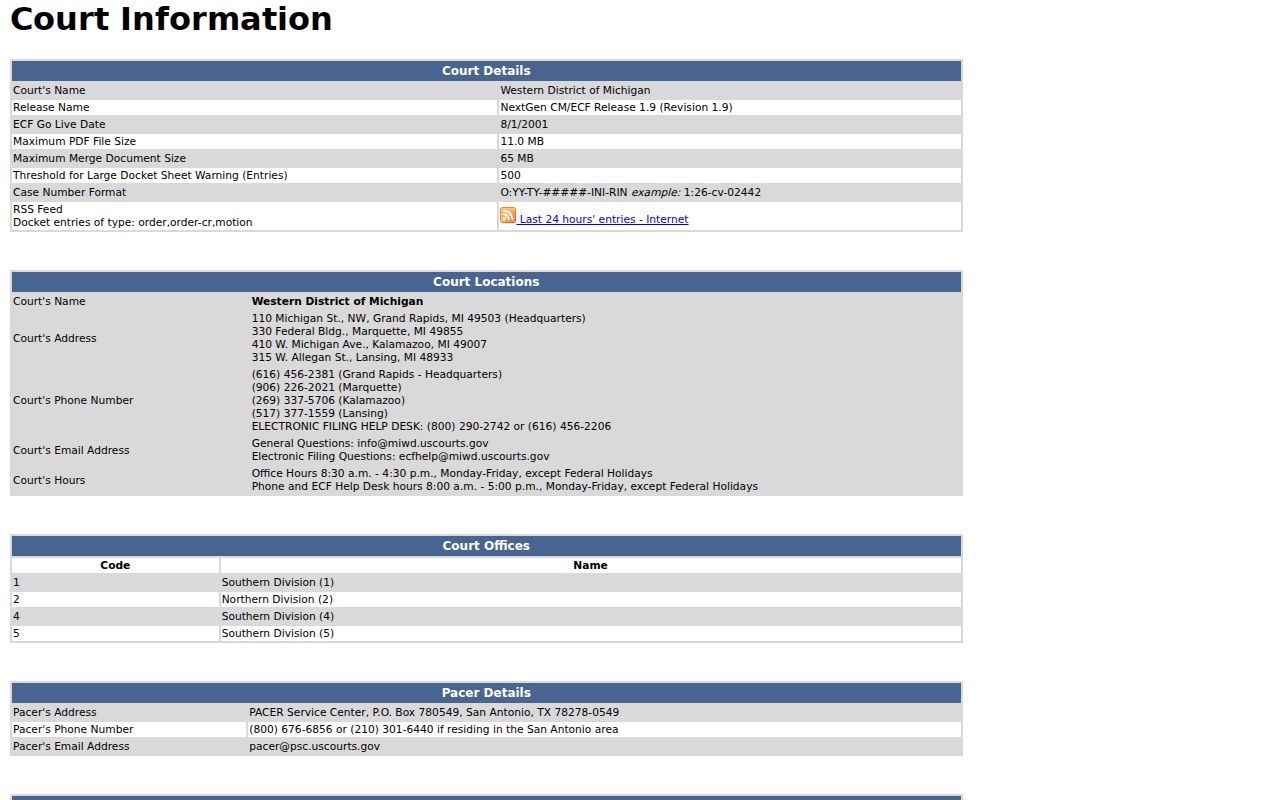
The federal side stays separate, and the D60-to-C14 route still governs Muskegon Heights court records at the county level.
Who Can See Muskegon Heights Court Records
Go to the court that holds the file. That is where any Muskegon Heights court record you want to see sits. Under MCR 8.119, anyone may inspect and copy a public record. Reading a public case history at the courthouse costs nothing. Copies or certified versions may carry a fee. MiCOURT handles the public case-history search. The D60 counter covers a district file, and Circuit Court Records covers a C14 file. Skip the county FOIA process for court records, since it does not apply. A city-origin document runs through that agency's own channel. That means something the City of Muskegon Heights itself issued.
Not everything shows up in an ordinary search, though. Juvenile proceedings, sealed cases, suppressed matters, protected personal data, and certain excluded categories all face limits. A public case can list basics while holding back protected fields or documents. A blank result never proves the record is gone. And a city record request cannot push past a restriction the court has imposed.
Michigan access rules:
MCR 8.119 permits public inspection and copying unless a statute, court rule, or order restricts the record.
Michigan Administrative Order 2006-2 ties court-record access to the court rules and authorized access rules.
MCL 712A.28 generally restricts public access to juvenile records, subject to statutory exceptions.
Muskegon Heights City and Court Records
Muskegon Heights court records and city-origin records are not the same thing. A police report, a city ordinance matter, or an administrative item belongs to the city or the agency that issued it. D60 is where a filed district case lives. That means its case history, setting, responsibility finding, judgment, costs, and court copies. Once a matter reaches the 14th Circuit Court, go to Circuit Court Records. Need a certified copy? Ask the clerk of whichever court holds the file when you make the request.
The split matters when you read a balance. It also matters for a notice. A city record can prove an administrative detail. It does not by itself amount to a court disposition. For dated court events, the public D60 case history is the source. MiCOURT can find the public case. The counter or clerk can provide a copy the court releases.
Note: Confirm who holds the record first. Order a Muskegon Heights copy only after that. Issuance, filing, and circuit transfer can scatter related papers across different offices.